For online expert and consulting businesses ready to install the AI Operating Layer their team can actually run
Your business has AI.
Critical work still depends on one person.
In 30 days, we rebuild three high-leverage workflows with your team so the work has clear ownership, shared context, human checkpoints, and AI support that holds when a key person is unavailable, the team changes, or the work comes under pressure.
Somewhere in your business right now there is an AI tool your team is using three different ways, a workflow nobody fully owns, and a decision sitting in someone's inbox waiting for the one person who knows how to make the call. That is a single point of failure inside critical work. And it's exactly what we fix.
It's Wednesday at 4pm. You're supposed to be working on Q3 strategy. Instead you're in Slack explaining something for the third time this week to someone you hired to handle exactly this.
You need the structure that lets your team put AI to work so you can go back to the work that lights you up.
You had an idea for a new offer six months ago.
It's still in a Google Doc. Not because it's a bad idea. Because there's nobody in your business who can take it from your head and make it real without you project managing every step.
That's the gap. Not strategy. Not talent. Not tools. There's no one who holds what you hold. No one who carries the full picture. No one who makes the judgment calls when you're not in the room. So everything waits for you. And you're out of capacity to give.
You've been meaning to fix your systems for years. You've tried. You've added tools. You've customized platforms. But nothing talks to each other, and the workarounds have workarounds. And now someone's suggesting you layer AI on top of all of it.
Meanwhile your revenue goes up when you're on and down when you're not. Because you are the system. When the business runs on your judgment, your attention, and your capacity, income follows your bandwidth, not your strategy. That's a structure problem.
The AI problem is a team structure problem.
Are you a Visionary trapped as your own Integrator?
Or are you the Operations Manager trying to keep your head above water while every new change becomes yours to make real?
Read this list. If it feels like your autobiography, keep scrolling.
- Your team brings you every decision because nobody knows who has the final authority to make the call
- You bought AI tools and everyone uses them differently. No standards, no consistency, no way to know if it's helping or creating new problems
- Your last launch hit the number… barely. But you know it only happened because you were in every Slack channel, on every call, rewriting copy at 11pm
- You've hired three ops people in four years. Each one was talented. The pattern still didn't change
- You came back from vacation to a pile of things that just sat there waiting for you
- You blocked two hours for strategic thinking on Tuesday. By 10am you'd spent both hours answering questions and people managing
- Every automation you've built lives in your brain. If you disappeared tomorrow, nobody could run it
- You know exactly what to do. But you struggle to get it done with the tiny team you have
- You assigned a weekly deliverable to someone three months ago. It happened twice. Then it quietly disappeared
- Your bookkeeper recently flagged that you're spending $17K a month on subscriptions and you don't even know what half of them are
- Your systems sort of work. But they aren't connected. The CRM doesn't talk to the project tool. The project tool doesn't talk to the calendar. Everything moves. Just in separate windows, with a human copy-pasting between them
- You're the rainmaker. And the one filling the rain. You convert. You deliver. You follow up. You fix what breaks. Your income goes up when you're on, and down when you're not. Because the business is still running on you, not on systems
- You know the systems that got you here won't get you to the next stage. But every time you try to fix them, the business needs you for something else
- You have good months and rough months. And you can always trace the rough ones back to the same thing: you were deep in delivery, or deep in a launch, or just out of bandwidth. The pipeline dried up while you were busy holding everything else together

|
My name is Kristen Arnold. I founded Business Builders United. My title is Builder & Strategic AI Operations. I help founder-led expert businesses increase execution capacity, remove single points of failure, and build teams that use AI well. |
I rebuild the way work gets done after the team, the org chart, and the business have changed.
For the last four years, I have worked inside founder-led expert businesses that were restructuring, rightsizing, rebuilding after key people left, or adapting around leaner teams. I clarified ownership after the org chart changed, cut cost without cutting quality, rebuilt critical workflows, led launches under pressure, and helped teams adopt AI without creating new single points of failure.
I know how to rebuild the way work gets done when the team, the org chart, and the business have all changed. Now I apply that operating experience to AI adoption.
As COO of an early-stage AI startup, I saw what happens when promising technology is introduced without the operating foundation required to make it work. A tool can look functional while the ownership, context, standards, and human judgment underneath it have already failed.
Before that, I spent 13 years inside Jeff Walker's Product Launch Formula, including four years as COO. We built a team that could make decisions and execute under pressure without routing every call back through Jeff.
Here's what that actually looked like. Cart opened at 7am Eastern on a Tuesday. By 2pm we were 30% behind projection. I pulled three people into a room, adjusted the email sequence, shifted the ad budget, reassigned resources. By midnight we'd closed the gap. Jeff never had to get on a call. Because we had the structure to hold it.
Jeff could take four weeks on the river without a cell phone. Not because he checked out. Because he trusted us. He knew we'd make the decisions, problem-solve, and triage whatever came up. That trust didn't happen by accident. We built it over 13 years, one judgment call at a time.
That's what an Integrator does. Not in theory. At 2pm on a Tuesday when real revenue is on the line. Now I build that structure for your business. And show your team how to run AI inside it.
The AI-Ready Team
The AI Operating Layer install.
An agentic workflow is a process where AI handles repeatable work and your team makes the judgment calls. It runs with a named human owner, shared business context, clear standards, and checkpoints for review.
We work through three of them. Why only three? Because most teams aren't failing at AI, they are drowning in it. Too many tools, too many opinions, too many disconnected pieces that don't talk to each other. Three workflows done right beats ten done halfway.
|
You show up.
You bring the business context. We make the judgment calls on priorities together. Your job is to bring what your team knows about how the work really runs.
|
We build it. Your team owns it.
We rebuild each workflow live with your team in the room. They ask questions, document the steps in their own words, and run the first live test themselves. By the end, they own what they helped build.
|
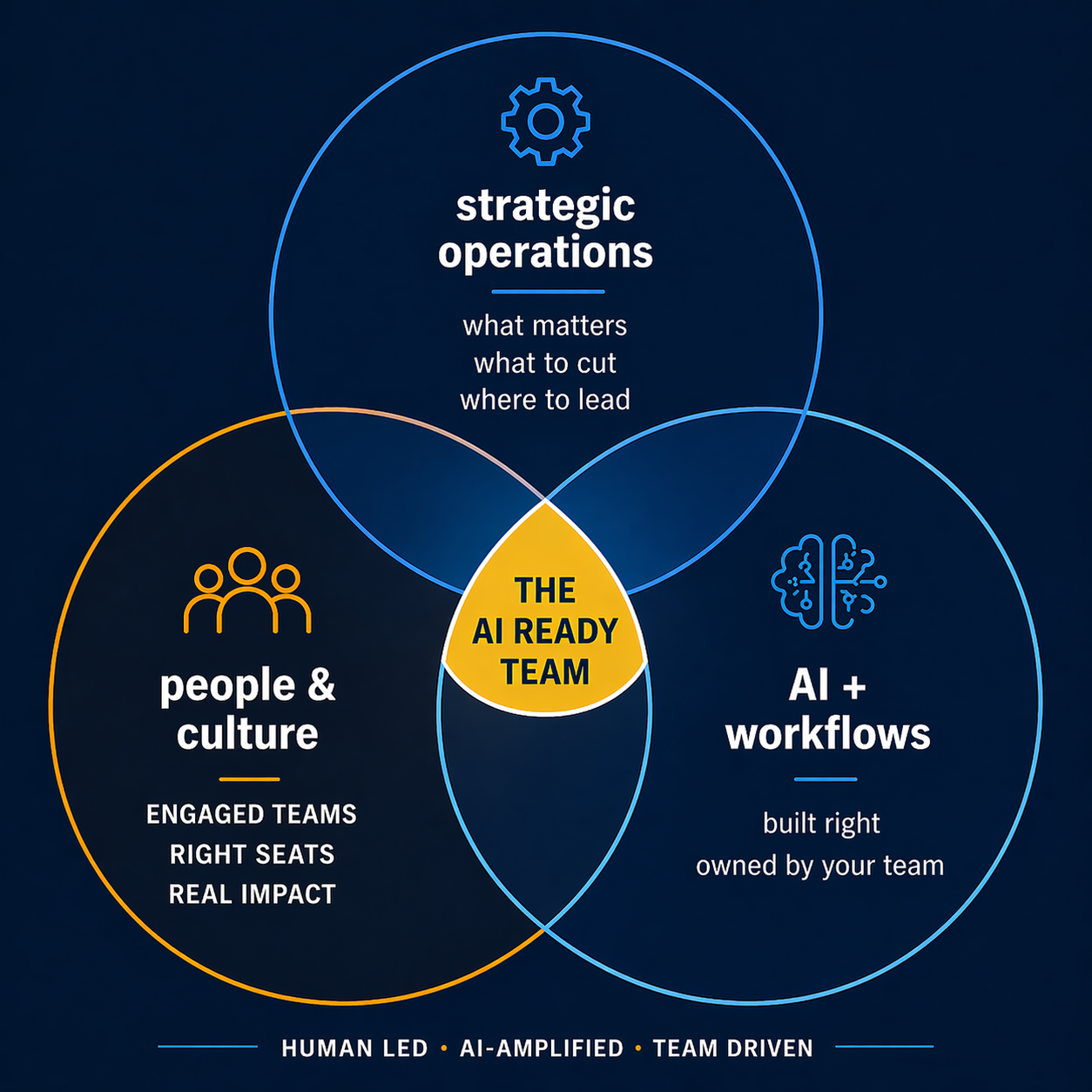
| FILTER | Cut the noise. Know what's actually worth their time. Your team can't act on everything. We build a simple filter for evaluating every new AI tool, so they stop chasing shiny objects and start using the ones that actually move your business. No more "should we be using this?" paralysis. |
| STRUCTURE |
Rebuild 3 agentic workflows your team actually owns.
I build each workflow live, in the session, with your team watching, learning and participating. They document the steps in their own words as we go. Not after. Not from a handoff doc I wrote. The knowledge lives with them from the moment it's built, because they were in the room when it happened. No more "only Kristen knows how this works."
The engagement covers 3 specific agentic workflows, chosen in Session 1 based on where the clearest gains are. Three workflows done right beats ten done halfway. |
| PEOPLE | Right seats. Lasting knowledge. We define who runs what and make sure the right people are in those roles. If your team is ready, we train and transfer. If a seat needs the right person, we figure that out too. Knowledge doesn't live in one brain anymore. |
In every founder-led business I've worked with, the same three things show up. Every time. Different business, different industry, different team size. Same diagnosis.
There is always critical work concentrated in too few people. A workflow depends on the founder watching, an ops lead remembering the workaround, or a specialist carrying context nobody else has. There is always another place where AI is being used reactively instead of running inside a real workflow with a human owner.
The workflows are always specific to your business. The pattern is always the same. Session 1 is where we find yours.
What your team has at the end
- Three working AI-supported workflows tested with real work
- A named human owner for each outcome
- Shared context that does not live in one person's head
- Clear decision rights, approvals, and escalation points
- Documented handoffs the team can follow
- A 30-day continuation plan
How the 4 sessions work
|
Session 1
Discover
|
You leave with: A playbook of your 3 highest-impact workflows and a clear starting point. |
|
Session 2
Filter
|
You leave with: Your AI filter framework, documented and ready for your team to use immediately. |
|
Session 3
Structure
|
You leave with: 3 workflows rebuilt, documented, and tested with your team running them. |
|
Session 4
Transfer
|
You leave with: A role ownership map your team can run from. Without you in every conversation. |
|
$6,500
One time. No ongoing fees.
|
90
minutes Per session. Four sessions over 30 days.
|
3
workflows Built, tested, and owned by your team.
|
I'm personally involved in every engagement.
Because I'm on every session and rebuild the workflows hands-on with your team, I only take 2–3 clients at a time. When those spots fill, the next opening is 4–6 weeks out.
This isn't theory. These are receipts.
"The level of ownership that Kristen took for every aspect of her position was breathtaking. Revenue grew almost 300%. Team size grew almost 10x. That level of growth creates a huge demand for flexibility, agility, and sheer grit. Kristen never failed to answer the challenge."— Jeff Walker, creator of Product Launch Formula, #1 NY Times bestselling author
"She overhauled the systems, streamlined the staff, put critical processes in place and supported me in every possible way. Today our business is dramatically healthier, leaner, more productive, more profitable and so much more fun for me to run. She essentially worked herself out of a job by fixing my business."— Shelley Brander, CEO & Founder, Knitstars.com
"Anytime you're looking to grow a company, you want guidance from someone who has done what you're trying to do. It's a chance to cut decades off your learning curve. And that's exactly what you'll get when working with Kristen. She was instrumental in scaling the company and systematizing the operations. It ran like a well-oiled machine."— Stu McLaren, Creator of The Membership Experience & Co-Founder of Membership.io
Nobody cares about the framework. They care about Tuesday.
Here's what Tuesday looks like after we're done.
- You land back from a week in Italy. You open your laptop. Nothing is on fire. The team made the calls. Revenue held. You close the laptop and pour another espresso.
- Your ops lead says "I handled the vendor issue" and for the first time you don't open the thread to check their work.
- AI runs inside your business every day. You didn't prompt a single thing this week. Your team did. Because they built the systems and they know how they work.
- Launch week happens. You do one live, record one video, show up for two strategy checkpoints. Your team runs everything else. You sleep.
- You come back from your next mastermind with three ideas. Your team pulls up the capacity plan and says "we can start two of these next month." Nobody groaned. They just planned.
- You open Slack on Monday morning and there is nothing urgent. You read that sentence again because you've never experienced it.
Where is critical work depending on too few people?
Most founders have seen the signs for years. A decision waits for them. A launch stalls when the lead is unavailable. A workflow works because one operator remembers the undocumented steps. AI makes the cost of that concentration visible every day. Every tool update, new agent, and "should we be using this?" question tests whether the team has the structure to decide.
13 yes/no questions. Takes two minutes. Your score shows where the business still depends on one person watching.
Take it with your ops lead. Compare your answers. If you answer differently, that gap is telling you something important.
Fair warning: in this scorecard, a high score is not a good thing.
In this scorecard, high is not winning.
Score 40% or above? That's exactly what The AI-Ready Team is built to solve. → Get started for $6,500
Most automation consultants are solving the wrong problem.
They come in, look around, and start building. SOPs get documented. Files get organized. Zapier connects to everything. Notion gets a makeover. It all feels like progress. None of it moves revenue.
Here's why: you can't automate a business that's still being built while the plane is flying. If your lead generation process changes every launch, automating it just locks in the wrong version faster. If your fulfillment depends on judgment calls only you can make, an agent running it will make the wrong calls at scale. Automation without a strategic filter doesn't fix the business. It freezes the chaos in place.
The governing question is: "What are the two or three workflows responsible for your leads, revenue, and fulfillment, and stable enough for the team to run?" We find those first. Then we build.
That's the filter that's missing from almost every AI and automation engagement. And it's the only reason any of it sticks.
One more thing: the AI landscape keeps changing. What was best practice last quarter may be retired this quarter. During the engagement, I bring the filter so we make decisions based on what matters for your business. Your team leaves with that filter documented, so every new tool does not become another fire drill.
No strategy meeting required. No application. No pitch.
If you know your team needs this, you can start right now.
Your team is ready. Let's build the structure to prove it.
4 sessions. 30 days. 3 agentic workflows rebuilt and owned by your team.